If you open the business section of a Malaysian newspaper, you are bombarded with alphabet soup: ASEAN, APEC, CPTPP, RCEP. It sounds like a confusing menu of government acronyms.
THE PLAYERS: WHO IS WHO?
A quick guide to the acronyms shaping our economy.
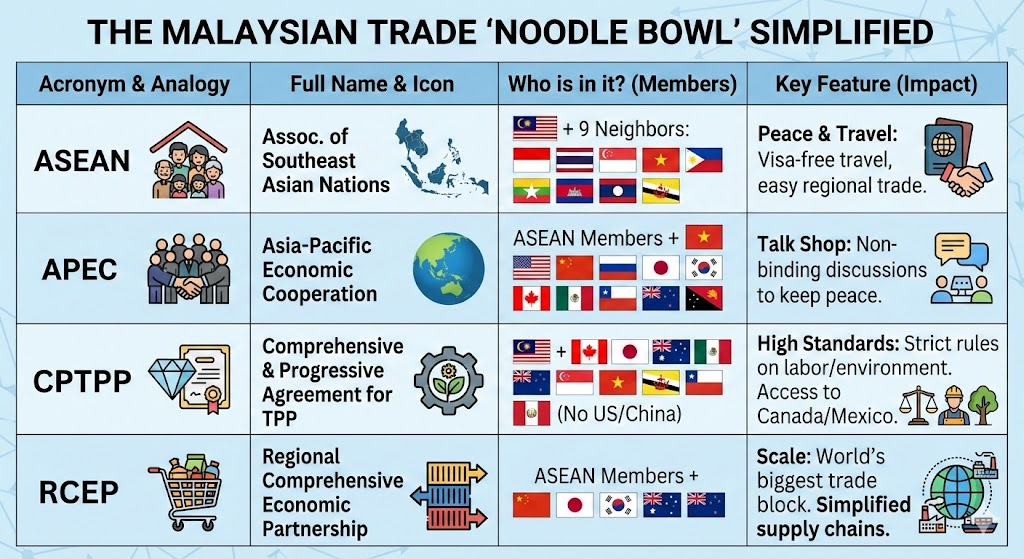
| Acronym | Full Name | The Analogy | Who is in it? | Key Feature |
| ASEAN | Assoc. of Southeast Asian Nations | The Family 👨👩👧👦 | 🇲🇾 + 9 Neighbors (Indo, Thai, Sg…) | Peace & Travel: Visa-free travel, easy regional trade. |
| APEC | Asia-Pacific Economic Cooperation | The Networking Event 🤝 | ASEAN + 🇺🇸 🇨🇳 🇷🇺 🇦🇺… | Talk Shop: Non-binding discussions to keep peace. |
| CPTPP | Comprehensive & Progressive Agreement for TPP | The Elite Club 💎 | 🇲🇾 + 🇨🇦 🇯🇵 🇦🇺 🇲🇽 (No US/China) | High Standards: Strict rules on labor/environment. Access to Canada/Mexico. |
| RCEP | Regional Comprehensive Economic Partnership | The Hypermarket 🛒 | ASEAN + 🇨🇳 🇯🇵 🇰🇷 🇦🇺 🇳🇿 | Scale: World’s biggest trade block. Simplified supply chains. |
But these aren’t just boring meetings in Putrajaya. These agreements are the reason you can buy affordable Japanese electronics in KL, why Australian beef is accessible at the supermarket, and why a small sambal entrepreneur in Johor might suddenly be able to sell to Canada duty-free.
Here is a layman’s guide to understanding the trading systems that keep Malaysia’s economy spinning.
1. The “Old Guard”: APEC and ASEAN
Think of these two as the foundation of our neighborhood.
ASEAN (The Family)
- What is it? The Association of Southeast Asian Nations. This is our immediate family: Malaysia, Indonesia, Singapore, Thailand, Vietnam, and 5 others.
- How it works: We operate on the “ASEAN Way.” Just like a typical Asian family, we value harmony. We discuss things politely until everyone agrees (consensus).1 We don’t like to interfere in each other’s “household” affairs.
- Why it matters to you: This is why you can travel to Thailand or Indonesia without a visa. Economically, the AEC (ASEAN Economic Community) tries to make it as easy to sell Malaysian biscuits in Jakarta as it is in Penang.
APEC (The Networking Club)
- What is it? Asia-Pacific Economic Cooperation. This is a much bigger club that includes the “big bosses” like the USA, China, and Russia, along with us.
- How it works: Unlike ASEAN, APEC is non-binding. It’s like a massive networking event or a “talk shop.” Leaders meet to discuss big ideas (like “let’s make trade easier”), but they don’t sign legally binding treaties that force them to change their laws immediately.
- Why it matters: It keeps the conversation going between superpowers, which helps prevent trade wars that could hurt our economy.
2. The New Giants: CPTPP vs. RCEP
This is where it gets interesting. These are the two massive, modern “mega-agreements” that Malaysia has joined.2 Think of them as two different types of gym memberships.
CPTPP (The “Premium” Club)
- Full Name: Comprehensive and Progressive Agreement for Trans-Pacific Partnership.
- Members: 11 countries including Malaysia, Japan, Canada, Australia, and Mexico. (Notably, the USA pulled out, and China is not a member).
- The Vibe: This is the “Gold Standard.” To get into this club, you have to follow strict rules. It’s not just about removing taxes (tariffs); you also have to promise to treat your workers well, protect the environment, and be transparent about government contracts.
- Impact on You:
- New Markets: For the first time, Malaysia has a trade deal with countries like Canada and Mexico.
- Cheaper Imports: Taxes on things like Canadian lobsters or automotive parts are slashed.
- High Standards: It pushes Malaysian industries to be more efficient and fair to compete globally.
RCEP (The “Massive Marketplace”)
- Full Name: Regional Comprehensive Economic Partnership.
- Members: All 10 ASEAN countries + China, Japan, South Korea, Australia, and New Zealand.
- The Vibe: This is about scale. It creates the world’s largest free trade zone.8 It doesn’t have the strict “labor and environment” rules of the CPTPP. Instead, it focuses on fixing the “spaghetti bowl” (or noodle bowl) of rules so that it’s easy to move parts around Asia.
- The “Made in Asia” Rule: This is the game-changer.
- Scenario: You make a bicycle in Selangor. You buy the gears from Japan, the frame from China, and the tires from Thailand.
- Before RCEP: You might have to pay taxes on all those parts individually when selling the bike to Australia.
- With RCEP: Because all those countries are members, the whole bike counts as “RCEP-origin.” You pay one low (or zero) tax rate. This makes Malaysian factories very attractive to foreign investors.
THE “MADE IN ASIA” GAME CHANGER (RCEP)
How the “One Rule” system boosts Malaysian factories.
BEFORE RCEP:
- Make a Bike in Selangor 🚲
- ⚙️ Gears from Japan (Taxed)
- 🔩 Frame from China (Taxed)
- 🛞 Tires from Thailand (Taxed)
- Export to Australia: ❌ High Tax (Because parts are from “everywhere”)
WITH RCEP:
- Make a Bike in Selangor 🚲
- ⚙️ Gears from Japan (Tax-Free)
- 🔩 Frame from China (Tax-Free)
- 🛞 Tires from Thailand (Tax-Free)
- Export to Australia: ✅ 0% Tax (Because all parts are from “RCEP Family”)
Result: Investors build factories in Malaysia because we are the perfect assembly hub.
3. The China Connection: Belt and Road Initiative (BRI)
While CPTPP and RCEP are about rules and taxes, the BRI is about hardware.
- What is it? China’s global plan to build infrastructure (ports, railways, power plants) to connect trade routes.
- In Malaysia: Projects like the ECRL (East Coast Rail Link) fall under this umbrella.
- The Goal: To physically make it faster to ship goods from Kuantan to Port Klang, and eventually to the rest of the world.
Summary Table: Which is Which?
| Feature | ASEAN | CPTPP | RCEP |
| Analogy | The Family Unit | The Elite Country Club | The Giant Hypermarket |
| Key Members | Malaysia + 9 Neighbors | Malaysia + Canada, Japan, Aus… | ASEAN + China, Japan, Korea… |
| Main Benefit | Regional peace & easy travel | High standards & new markets (Canada/Mexico) | Supply chain efficiency (Made in Asia) |
| US/China? | Neither | No US, No China | Has China, No US |
Why Should You Care?
- Job Security: Malaysia is a trading nation. We export more than we consume. These agreements ensure that factories in Penang, plantations in Sabah, and tech hubs in Cyberjaya have customers overseas.
- Cost of Living: When import taxes drop (thanks to RCEP/CPTPP), the cost of imported raw materials drops. This should (in theory) keep prices of finished goods like cars, phones, and food lower.
- SME Opportunities: If you run a small business, the government now has specific grants and programs to help you export to these CPTPP/RCEP countries. The market is no longer just 33 million Malaysians; it’s billions of people.
Here is the expansion on how these trade deals specifically hit your wallet, your career, and your business.
1. Job Security: The “Step Up or Step Out” Effect
The impact on jobs is a double-edged sword: it creates more high-paying roles but puts pressure on low-skilled ones.
- The Winners (Engineering & Tech): The CPTPP and RCEP make Malaysia a massive hub for the Electrical & Electronics (E&E) sector. Because we can now export microchips to Canada or Japan tax-free, multinational companies (like Intel or Dyson) are incentivized to expand their factories here. This creates a surge in demand for engineers, technicians, and QA specialists. If you are in these fields, your job security just went up.
- The Challenge (Traditional Manufacturing): On the flip side, local factories that rely on “old school” low-cost labor without automating might struggle. Suddenly, a factory in Vietnam or a firm in China can sell the same plastic cup or garment to Malaysia more easily. Workers in low-skill manufacturing need to upskill to remain secure, as their employers face fiercer competition from our neighbors.
- New “Compliance” Jobs: The CPTPP requires companies to follow strict rules on labor rights and environmental data. This has created a mini-boom for HR managers, compliance officers, and sustainability consultants who can help Malaysian companies avoid getting sued or banned from exporting.
2. Cost of Living: Cheaper Imports, But Maybe Not Immediately
You might not see the price of teh tarik drop tomorrow, but these agreements work silently to keep inflation in check for specific goods.
- Cheaper Groceries & Goods: Malaysia imports a lot of food and raw materials. Under these deals, import taxes (tariffs) are slashed on thousands of items.
- Example: High-quality beef from Australia or dairy from New Zealand enters with lower taxes.
- Example: The parts to repair your Japanese or Korean car become cheaper to import, potentially lowering service costs at workshops.
- The “Inflation Buffer”: When global inflation hits (like when shipping costs rise), having zero import tax acts as a buffer. While the item is still expensive, it would have been more expensive if the 15-20% government tax was still added on top.
- Consumer Protection: The CPTPP specifically has chapters on E-commerce. It forces member countries to protect online consumers against fraud and misuse of personal data. So, buying products from overseas platforms should theoretically become safer and more transparent.
3. SME Opportunities: From Kampung to Global
This is the biggest potential game-changer for the “little guy,” but only if they are brave enough to grab it.
- The “Golden Ticket” to New Markets: Before CPTPP, if a Malaysian SME wanted to sell Sambal Nyet or batik to Mexico or Canada, the taxes made it too expensive. Now, those taxes are gone. A small business in Kelantan can now competitively sell to a customer in Vancouver.
- Sourcing Raw Materials: It’s not just about selling; it’s about buying. A Malaysian furniture maker can now buy high-quality wood or varnish from any CPTPP/RCEP country tax-free, assemble the chair in Muar, and sell it to Japan. This lowers their production costs significantly.
- The Paperwork Hurdle: The catch? To enjoy these perks, SMEs must prove their product is truly “Malaysian-made” (Rules of Origin). This requires paperwork that many chinaman style companies aren’t used to. The government (MATRADE) offers grants to help, but SMEs that refuse to modernize their documentation will be left watching their competitors get rich.
IMPACT ON THE RAKYAT (YOU)
💼 JOB SECURITY
- The Boom: 📈 Engineering, Tech, & Compliance. (MNCs expand high-tech factories here).
- The Risk: ⚠️ Low-Skill Manufacturing. (Traditional factories face competition from cheaper neighbors).
- New Role: 🛡️ Sustainability Officers. (Companies need people to manage new “Green” rules).
💸 COST OF LIVING
- Cheaper Imports: ⬇️ Prices for imported beef (Australia), car parts (Japan/Korea), and raw materials.
- Inflation Shield: 🛡️ When global prices rise, zero import tax helps cushion the blow.
- Consumer Safety: 🔒 Better protection against online fraud when buying from CPTPP countries.
🚀 SME OPPORTUNITIES
- New Markets: 🇨🇦 🇲🇽 Sell Batik or Sambal to Canada & Mexico tax-free for the first time!
- Cheaper Costs: 📉 Buy raw materials (wood, chemicals) from 14 countries without paying duties.
- The Catch: 📝 Paperwork. Must prove goods are “Made in Malaysia” to get the perks.
4. THE BOTTOM LINE
- CPTPP = Better Quality (Standards, Rights, New Western Markets).
- RCEP = Better Flow (Cheaper parts, supply chain efficiency).
- Malaysia = The Winner (If we upgrade our skills and businesses).