From Putrajaya to Malaysians: How APEC Powers Malaysia’s Daily Life
Beyond the diplomatic handshakes, APEC is a silent engine driving better jobs, cheaper tech, and global opportunities for ordinary Malaysians.
When the news cycle covers the Asia-Pacific Economic Cooperation (APEC) summits, we often see a parade of world leaders in batik shirts, discussing “bilateral ties” and “multilateral frameworks.” It feels distant—a “Putrajaya problem” rather than a Kampung concern.
However, since Malaysia became a founding member in 1989, and notably after hosting the summits in 1998 and 2020, APEC has woven itself into the fabric of the Malaysian economy. It is not just a club for diplomats; it is a standardization machine that lowers the cost of your imported phone, helps a local engineer get a job in Australia, and ensures a Muar furniture maker can sell sofas to Chile without drowning in paperwork.
Here is an in-depth look at how APEC membership actively shapes the future for the everyday Malaysians.
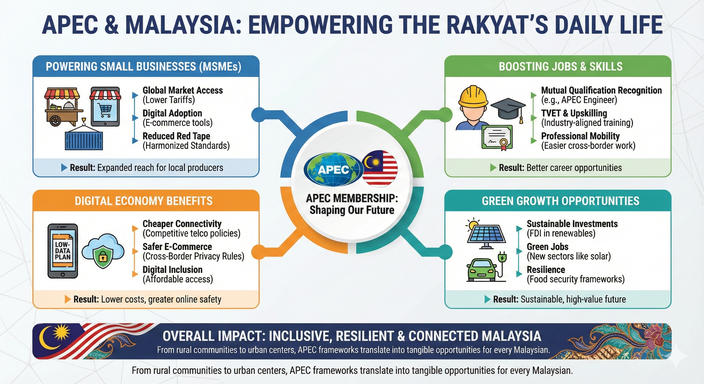
1. How APEC is Empowering SMEs & Micro-Businesses on a Day-to-Day Basis
Micro, Small, and Medium Enterprises (MSMEs) make up 97.4% of all businesses in Malaysia. APEC’s primary goal in recent years has been “inclusive growth”—ensuring these small players aren’t crushed by giants.
The “Digital or Die” Transformation
APEC’s Internet and Digital Economy Roadmap isn’t just a document; it triggers domestic funding and training.
- Real-World Example: Consider XIXILI, a homegrown Malaysian lingerie brand. During the pandemic—a crisis APEC actively managed through its “COVID-19 Live” information sharing—XIXILI utilized digital tools to introduce a “virtual fitting room.” This shift wasn’t random; it aligns with APEC’s push for O2O (Online-to-Offline) transformation.
- The Benefit: APEC initiatives push for “paperless trade.” For a small business selling sambal or batik online, this means simpler customs forms and digital invoicing, allowing them to ship to customers in Japan or the US without needing a massive legal department.
Green Supply Chains
Global buyers now demand “green” products. APEC helps Malaysian companies meet these standards so they don’t lose contracts.
- Real-World Example: Duramitt Sdn Bhd, a Malaysian glove manufacturer, utilized APEC-promoted green frameworks to switch to biomass fuel, reducing carbon emissions. This compliance allows them to keep exporting to strict markets like the EU and North America, preserving local factory jobs.
2. Professional Mobility
For Malaysian professionals, APEC is a passport to a global career without actually having to emigrate permanently. It creates a framework for “Brain Circulation” rather than “Brain Drain.”
The APEC Engineer Register
This is one of the most tangible benefits for technical professionals.
- How it works: Managed locally by the Institution of Engineers, Malaysia (IEM), the APEC Engineer Register allows Malaysian engineers to have their qualifications recognized in 14 other economies, including Australia, Japan, and the USA.
- The Impact: If a Malaysian civil engineer wants to work on a project in New Zealand, being on this register cuts through months of red tape. It validates that their degree from UM or UTM is “substantially equivalent” to a degree from Auckland or Tokyo.
TVET and Vocational Training
APEC is heavily invested in vocational training (TVET). By harmonizing standards, a welder certified in a Malaysian polytechnic is increasingly recognized as meeting the safety standards required by multinational companies operating in Penang or Johor. This raises wages and skill ceilings for non-university graduates.
3. The Digital Wallet: Lowering Costs & Protecting Data
Malaysia’s “MyDIGITAL” blueprint is directly synced with APEC’s regional digital goals. This alignment brings two main benefits to your wallet:
Cheaper, Faster Connectivity
APEC pushes for “telecommunications liberalization.” In simple terms, this means breaking up monopolies and encouraging competition.
- The Result: The competitive pricing wars we see among Malaysian telcos (providing 5G data plans that are among the cheapest in the region) are partly driven by these open-market commitments. APEC monitors these prices, pressuring economies to keep digital access affordable for the masses.
Scam Protection & Data Privacy
As we embrace e-wallets, cross-border scams become a threat. Malaysia is adopting the APEC Cross-Border Privacy Rules (CBPR) system.
- The Result: This ensures that when you buy goods from an overseas platform, or when a Malaysian startup stores data on a cloud server in Singapore, there is a unified standard of data protection. It makes the digital ecosystem safer for your banking details and personal info.
4. The “Green Lane” Legacy: Crisis Resilience
We often forget that during the height of COVID-19, trade borders were snapping shut. Malaysia, as the host of APEC 2020, led the Putrajaya Vision 2040.
Ensuring Food Security
Malaysia championed a “Green Lane” for essential goods. While tourists couldn’t travel, APEC agreements ensured that ships carrying rice, medical supplies, and raw materials were not stopped.
- For the Rakyat: This prevented catastrophic shortages of essential food items and medicine in Malaysian supermarkets during the lockdown. It is a safety net that remains in place for future crises.
5. Future-Proofing: The Green Economy
The National Energy Transition Roadmap (NETR) requires billions of Ringgit in investment. APEC is the conduit for this money.
- Just Energy Transition: APEC’s “Green Finance” principles encourage wealthy member economies (like the US and Japan) to invest in developing members’ transition projects.
- The Outcome: This leads to Foreign Direct Investment (FDI) in solar farms in Kedah or green hydrogen plants in Sarawak. These projects create high-value engineering jobs in rural areas, decentralizing wealth away from the Klang Valley.
Summary: The Putrajaya Vision 2040
The old “Bogor Goals” of 1994 were about free trade. The new “Putrajaya Vision 2040,” birthed in Malaysia, is about Shared Prosperity.
For the ordinary Malaysian, this shift is critical. It moves the goalposts from “just making GDP go up” to “making sure the makcik selling nasi lemak has a digital payment QR code, the fresh graduate has a globally recognized degree, and the air we breathe is cleaner.”
Bottom Line: APEC is the invisible scaffolding that supports Malaysia’s modernization. It ensures that when Malaysians work hard, the international door is open for them to succeed.